
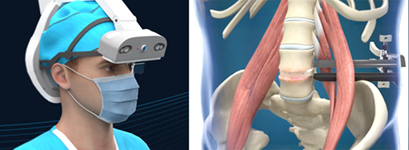
What is Minimally Invasive Lateral Fusion with Augmented Reality Navigated Placement of Posterior Spinal Instrumentation?
Minimally invasive lateral fusion with augmented reality navigated placement of posterior spinal instrumentation is a modern spinal surgery technique used to treat spinal conditions with greater precision and minimal tissue disruption. It combines two advanced methods:
- Minimally Invasive Lateral Fusion: This part of the surgery involves accessing the spine from the side (lateral approach), avoiding disruption to major back muscles. Through small incisions, the surgeon removes the damaged disc between vertebrae and inserts a cage or bone graft to promote fusion.
- Augmented Reality (AR) Navigated Placement of Posterior Spinal Instrumentation: After the lateral fusion, screws and rods (posterior instrumentation) are inserted into the spine to stabilize it while the fusion heals. Surgeons use 3D imaging and AR headsets or monitors to “see through” tissues and precisely guide instruments.
What are the Indications for Minimally Invasive Lateral Fusion with Augmented Reality Navigated Placement of Posterior Spinal Instrumentation?
The common indications for minimally invasive lateral fusion with augmented reality navigated placement of posterior spinal instrumentation include the following:
- Degenerative disc disease
- Spondylolisthesis
- Lumbar spinal stenosis
- Spinal instability or deformity
- Recurrent disc herniation
- Failed previous back surgery
What Does the Procedure for Minimally Invasive Lateral Fusion with Augmented Reality Navigated Placement of Posterior Spinal Instrumentation Involve?
In general, the procedure is typically performed in two stages under general anesthesia and involves the following:
- The patient is positioned on their side for the lateral (side) access portion of the procedure.
- A small incision is made on the side of the abdomen or flank.
- Using specialized minimally invasive retractors and fluoroscopic guidance, the surgeon carefully accesses the spine between the abdominal organs and muscles without cutting through them. The damaged intervertebral disc is removed.
- An interbody cage or spacer filled with bone graft material is inserted into the disc space to restore disc height and promote bone fusion between adjacent vertebrae.
- The patient is then turned onto their stomach (prone position) for posterior access.
- Using an augmented reality (AR) navigation system (such as a headset or AR screen), the surgeon overlays 3D spinal images onto the patient’s anatomy in real-time.
- Pedicle screws are inserted with high precision into the vertebrae through small stab incisions in the back.
- Connecting rods are placed to stabilize the spine while the fusion occurs.
- All incisions are closed with sutures or staples, and sterile dressings are applied.
What Does Postoperative Care for Minimally Invasive Lateral Fusion with Augmented Reality Navigated Placement of Posterior Spinal Instrumentation Involve?
After the surgery, the patient is moved to recovery room for post-anesthesia monitoring. Patients typically stay in the hospital for 1–3 days, depending on their recovery. Pain is managed with medications, and physical therapy may begin within 24 hours to promote movement and prevent stiffness. Wound care instructions are provided to keep the small incisions clean and dry. Walking is encouraged early, but bending, twisting, and heavy lifting are restricted for several weeks. Follow-up visits include imaging to assess fusion progress and hardware placement. Most patients can gradually return to normal activities over 6 to 12 weeks, depending on the complexity of the case and individual healing.
What are the Risks and Complications of Minimally Invasive Lateral Fusion with Augmented Reality Navigated Placement of Posterior Spinal Instrumentation Involve?
Risks and complications associated with minimally invasive lateral fusion with augmented reality navigated placement of posterior spinal instrumentation include the following:
- Infection
- Nerve or blood vessel injury
- Bleeding or hematoma
- Hardware misplacement or failure
- Nonunion or failed fusion
- Persistent pain
What are the Benefits of Minimally Invasive Lateral Fusion with Augmented Reality Navigated Placement of Posterior Spinal Instrumentation?
Minimally invasive lateral fusion with augmented reality navigated placement of posterior spinal instrumentation offers several benefits over traditional open surgery and include the following:
- Smaller incisions, less tissue damage
- Enhanced precision and safety using AR navigation
- Faster recovery and less postoperative pain
- Reduced infection and blood loss risks
- Improved surgical outcomes and hardware placement accuracy